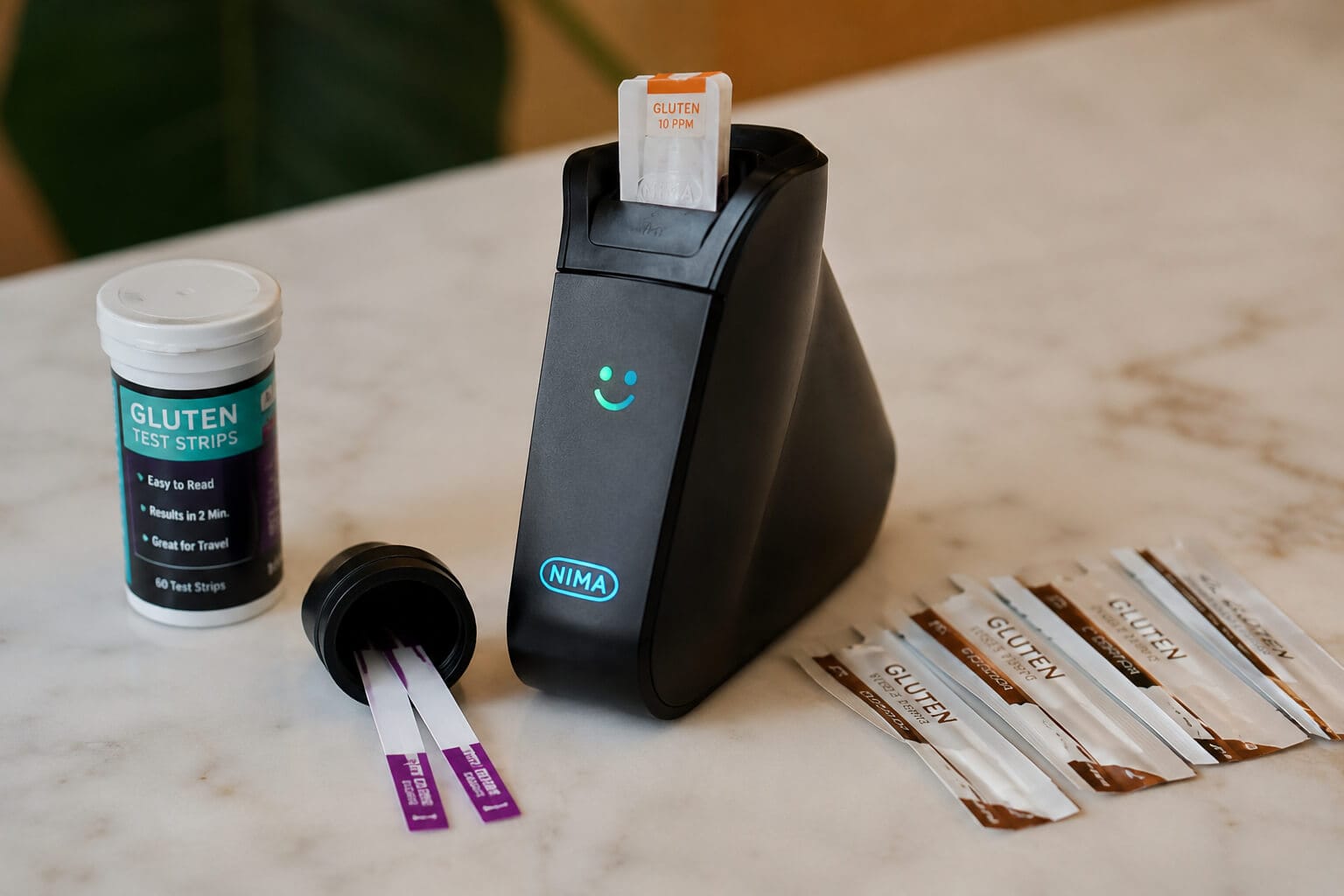
One person is standing in a restaurant with a pocket-sized reader. Someone else at a nearby table is holding a flat test strip pulled out of a wallet. Both are checking the same kind of question about the same kind of plate: does the pricier gadget actually detect gluten differently, or does it just present the same result more neatly? The question of Nima Sensor vs gluten test strips isn’t as simple as either product’s marketing suggests.
The short version: the Nima Sensor and most gluten test strips sold on their own rely on nearly the same immunological foundation — antibodies binding to gluten proteins. The real difference sits around that reaction, not inside it: how the sample gets prepared, who or what reads the result, and how many manual steps land on the user.
This isn’t a contest between two separate detection technologies. It’s a comparison of two different ways of packaging the same underlying chemistry — without assuming upfront that an electronic device is automatically more accurate than a strip read by eye.
Nima Sensor and Gluten Test Strips Are Not Two Different Technologies
This is the single most important point in the entire comparison, so it’s worth stating first. Inside every disposable Nima capsule sits a miniature lateral flow test strip, running on the exact same lateral flow immunoassay (LFA) principle used by standalone gluten test strips sold separately. Nima itself describes the process on its own technology pages as an automated read of a strip housed inside a capsule — not as some separate detection method invented from scratch.
The confusion usually comes from lumping four distinct things into one phrase — “gluten test”:
- the test strip itself — the chemistry responsible for the antibody-protein reaction;
- the full test kit — the strip plus an extraction buffer, container, and sample-prep instructions;
- an automated reader — electronics that measure line intensity instead of a person;
- manual visual reading — where the user judges the result with their own eyes.
Nima bundles all four into one device: the strip is hidden inside the capsule, and the sensor does the reading. A typical standalone test strip usually stops at the third item on that list — the user prepares the sample and reads the line themselves. That doesn’t automatically make one method better; it just means one automates more steps than the other.
How Do Gluten Test Strips Actually Work?
Lateral flow immunoassay works by letting a liquid sample migrate across a strip coated with antibodies. The food sample first needs to be broken down and mixed with an extraction buffer that releases gluten proteins from the food matrix. The resulting extract is applied to one end of the strip, then travels by capillary action through a series of reaction zones.
If gliadin or another gluten protein fragment is present, it binds to the antibodies fixed on the strip, and a visible line appears after several minutes. A second, control line confirms the test ran correctly regardless of the result. Exact procedures vary by manufacturer: some kits call for weighing the sample, others rely on a rough “pea-sized” estimate, and some require shaking the extraction solution for a set amount of time.
A test strip is not a stripped-down, inferior version of a sensor — it belongs to the same family of immunochromatographic methods, minus the electronic layer that reads the result. Since the exact steps differ from one manufacturer to the next, treating “test strips” as one uniform category can be misleading.
And How Does Nima Work, Specifically?
The user’s side of the process is shorter because part of it moves inside the capsule. A pea-sized sample goes into a single-use capsule, which is inserted into the sensor — from there, the device mixes the sample with an extraction buffer, pushes the extract through an internal antibody-coated strip, and optically reads line intensity, showing a result after roughly three minutes.
According to current manufacturer specifications, the latest generation of the Nima Sensor detects gluten from wheat, barley, and rye at 10 ppm or higher in the tested portion, and independent lab testing by BIA Diagnostics reportedly confirmed that sensitivity at 99% accuracy under controlled conditions. Those figures come from the manufacturer and its testing partner, so they’re worth treating as a claim rather than an independently verified fact for every possible food. The full breakdown of the mechanism and its limits lives in our guide on how the Nima Sensor works.
Nima vs. Test Strips — Where the Real Difference Sits
Since the underlying chemistry is close, the practical question of Nima Sensor vs gluten test strips comes down to two things: sample prep and how the result gets read.
Sample Preparation
Nima runs extraction and mixing inside a sealed capsule — the user only touches the food itself while collecting the sample. A typical test strip puts more of the process in the user’s hands: weighing or measuring the sample, mixing it with a solution, sometimes filtering the mixture before it touches the strip. This isn’t a universal rule — specific kits vary, and some standalone strips also keep manual steps to a minimum.
Reading the Result
Electronic reading reduces one specific source of error — a faint line that’s hard to interpret by eye. Nima’s sensor analyzes the signal at the pixel level, where a human eye might hesitate. What it doesn’t remove are two other error sources: improper sample collection and the specific properties of the food being tested, both of which affect the result no matter who — or what — is reading the strip.
Portability and Cost
Nima is built as a complete consumer system: a reader plus separately purchased capsules. A standalone test strip can be just as portable, though how practical it is in the field depends on how many components the kit has and how the sample gets prepared. Pricing shifts often enough that a single universal figure wouldn’t stay accurate for long, so it’s left out here deliberately rather than guessed at.
Is Nima More Accurate Than a Test Strip?
There’s no simple “yes” here. The accuracy of any immunological test depends on several variables at once: the specific antibodies used, the extraction method, the food matrix being tested, sample size, how evenly gluten is distributed in the dish, and how heavily the product has been processed. The type of device — electronic reader or a manually read strip — is only one factor among these, and not necessarily the deciding one.
Nima points to independent lab testing by BIA Diagnostics, in which samples deliberately spiked with exactly 10 ppm of gluten — half the EU’s “gluten-free” threshold — were detected with a high success rate. On the other side, Gluten Free Watchdog, citing data published in the Journal of AOAC International, has noted that near the detection threshold, an earlier generation of the sensor could be inconsistent — the same approximate gluten concentration sometimes produced a positive result and sometimes a negative one. Both sources can be true at once: they describe different device generations under different test conditions, but together they show that a “99% accuracy” headline doesn’t close the topic on its own.
A test strip built on the same antibody classes runs into exactly the same biochemical limits. In practice, the difference between results more often comes down to how well the sample was collected than to one method being inherently superior to the other.
Why Can the Same Sample Give Different Results?
The answer is the food matrix — what the tested product is actually made of. Gluten proteins behave differently depending on whether the sample comes from something fatty, dense, acidic, fermented, hydrolyzed, or made of many ingredients. Fat can interfere with even mixing between the sample and extraction buffer, high acidity can affect protein structure, and heavy fermentation physically breaks gluten chains into smaller fragments that some antibodies no longer recognize.
That second mechanism — hydrolyzed gluten — affects Nima and antibody-based test strips equally, since the problem lives in the protein’s structure, not in whichever device is detecting it. Nima itself currently lists fermented or hydrolyzed foods, beer, soy sauce, vinegar, very fatty foods, and pure liquids as categories it doesn’t recommend testing — not because the sensor is faulty, but because the underlying detection chemistry has limited reach there.
False Positives and False Negatives, Explained
A false positive means the test indicates gluten is present when the tested portion doesn’t actually contain it at a level matching that result. A false negative is the opposite — the test shows no gluten, even though gluten is present at a level that should have been picked up.
Neither problem usually comes from the technology alone. More often, the source is the sample itself: gluten unevenly distributed through a dish, a portion that’s too small or not representative, something interfering with the chemical reaction, or simply the wrong spot being swabbed. Cross-contact — a stray crumb from a contaminated cutting board, for instance — can trigger a positive result even when the rest of the portion is gluten-free, and this applies equally to a Nima capsule and a standalone test strip.
10 ppm and 20 ppm — Where Do These Numbers Come From?
Ppm stands for “parts per million.” 10 ppm means 10 milligrams of gluten per kilogram of food; 20 ppm is double that, or 20 milligrams per kilogram. The internationally recognized Codex Alimentarius standard, adopted in both EU and US regulations, defines a product as “gluten-free” at the 20 ppm threshold.
The current generation of the Nima Sensor is calibrated to detect gluten from 10 ppm — below the labeling threshold. Some standalone test strips work at the same 10 ppm line; others let users adjust sensitivity. Three separate concepts are worth keeping apart here: a test’s stated detection limit, the level at which the device actually reacts in practice (which can differ from the stated limit), and the regulatory “gluten-free” threshold used on packaging.
Neither Nima nor a typical test strip returns an exact figure like “13 ppm” — both give a qualitative result: detected or not detected, without a lab-grade quantitative reading.
Does “No Gluten Detected” Mean the Food Is Safe?
Not automatically. A test result — whether it comes from a sensor or a strip — describes only the specific portion that was sampled, not the entire plate. “No gluten was detected in this sample” is a different statement from “this whole dish is gluten-free,” because gluten can be distributed unevenly across a meal — a single contaminated crumb can land on one bite while the rest of the portion stays clean.
Nima’s own materials make the same point directly: the result describes only the tested portion, not the full meal — and that logic applies to any test strip, regardless of brand.
Nima or a Test Strip at a Restaurant?
The restaurant scenario is where read time matters most in practice. A three-minute sensor result lets someone check a dish before it goes cold, while a typical strip-based test usually needs ten to twenty minutes — which in practice means testing a sample before the full plate arrives, or accepting that the meal will already be finished by the time the result shows up.
Neither method, however fast the read, replaces asking staff directly about ingredients and cross-contact procedures in the kitchen.
Nima or a Test Strip While Traveling?
Priorities flip on the road — weight, resilience to conditions, and how easily something packs matter more than read time. A sensor is one more piece of electronics that needs charging and capsules that need protecting from heat and humidity. A flat, disposable test strip doesn’t need a battery or special storage conditions, which tends to make it easier to fit into a carry-on.
What About EZ Gluten and GlutenTox?
The test-strip market includes a handful of specific products that differ in the antibodies they use, how extraction works, and how widely available they are outside the US — EZ Gluten is a self-contained, single-use kit with no electronics, while GlutenTox Home stands out for adjustable sensitivity. A full breakdown of pricing, turnaround time, and which product fits which scenario lives in our guide to Nima alternatives, including EZ Gluten and GlutenTox, which covers this ground in far more depth than fits here.
Which Should You Choose — Nima or a Test Strip?
There’s no single universal winner — the right pick depends on what the test will actually be used for most often.
A Nima-style sensor tends to make sense for someone who:
- eats out often and values a fast, three-minute read;
- wants to minimize manual steps during sample prep;
- prefers a clear automated result over judging a line by eye;
- tests regularly enough to justify the higher cost of the capsule system.
A test strip tends to make more sense for someone who:
- wants to keep the per-test cost down and doesn’t plan to test daily;
- is comfortable with a more hands-on sample-prep process;
- wants a direct look at the result line instead of relying entirely on electronics;
- needs a test built for a specific use case a given manufacturer supports, such as surface testing.
This is a set of trade-offs to weigh, not a ranking — the same four points on each list can tip the decision differently depending on how many times a month the test actually gets used.
When a Home Gluten Test Isn’t Enough
There are situations where no home test — sensor or strip — should be the only basis for deciding whether to eat something:
- food with an unusual, very fatty, or very dense matrix;
- fermented products, such as Asian sauces or certain vinegars;
- hydrolyzed gluten or foods that went through deep thermal processing;
- products where the test manufacturer doesn’t explicitly stand behind the result’s reliability;
- situations that call for a quantitative, lab-grade gluten measurement;
- suspected heavy, uneven contamination across an entire dish, not just one section.
In these cases, a label, a manufacturer’s certification, and a conversation with kitchen staff carry more weight than a result from a capsule or a strip. Our guide on hydrolyzed gluten and the Nima Sensor goes deeper into exactly why fermented and processed foods trip up antibody-based testing in general.
Nima Sensor vs Gluten Test Strips — The Bottom Line
Nima Sensor vs gluten test strips comes down to two packagings of the same immunological chemistry: the sensor automates sample prep and result reading, while a standalone test strip leaves most of that work in the user’s hands. Neither approach removes the underlying limits of antibody-based gluten detection — problems with sampling, food matrix effects, and protein fragments altered by fermentation or hydrolysis. Whatever form it takes, a test remains one additional source of information, not a substitute for reading labels and talking to kitchen staff.