Seven separate guides on this site each cover one Balkan country in detail — the restaurant addresses, the local phrasebook, the one dish that looks safe and isn’t. This page does something different: it lines those seven countries up side by side so a multi-country trip can be planned as one route, not seven unrelated errands. Anyone piecing together a longer gluten-free Balkans itinerary needs this comparison more than another list of cafés.
Two Ways the Countries Line Up on a Map
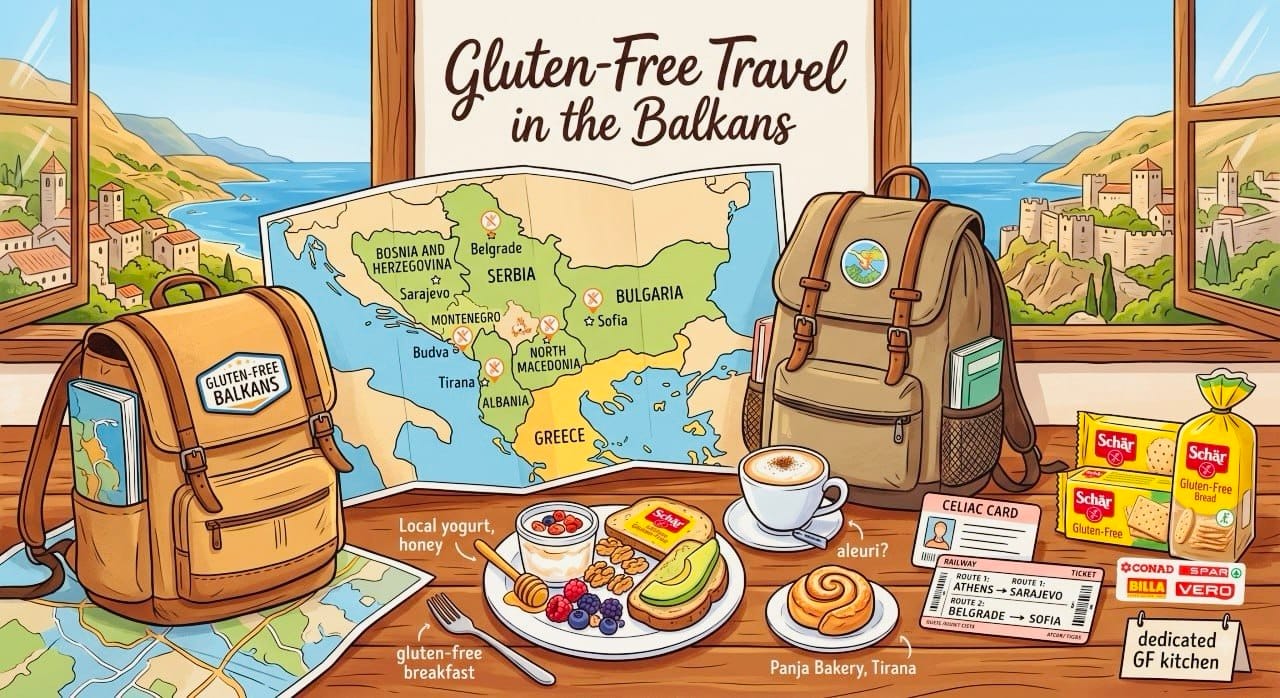
Four of the seven sit along a single coastal-to-inland stretch that many travelers already drive or bus in one trip. Starting in the south, Greece connects north into Albania along the Adriatic, which continues up the coast into Montenegro. From there the road turns inland toward Bosnia and Herzegovina, closing the loop back toward the Adriatic coast.
The other three form a separate, more inland arc through the eastern Balkans. Serbia connects south to North Macedonia, and from Skopje the route runs east into Bulgaria. These three share a rail and highway corridor that rarely overlaps with the coastal group above, so a trip built around Belgrade, Skopje, and Sofia tends to stay separate from one built around the coast.
EU Label or No Label
Only two of the seven — Greece and Bulgaria — belong to the EU, which means restaurant kitchens there operate under the EU’s mandatory allergen-disclosure rules. In the other five, that legal backstop doesn’t exist, and a printed celiac card does the job a menu label would otherwise do. That single fact matters more than most cuisine differences when deciding how much preparation a given leg of the trip actually needs.
One Grocery Brand, Seven Different Aisles
The Austrian-Italian brand Schär shows up in every one of the seven countries, just under a different local retailer each time. In North Macedonia it’s stocked at Vero and Tinex; in Bulgaria, at Billa and Kaufland; in Albania, at Conad and Spar. The packaging and the products barely change from one border to the next — only the supermarket name on the receipt does. Anyone crossing several of these countries in one trip can rely on the same brand name as a constant, even while the rest of the shopping list resets at every border.
A Fully Plant-Based Stop in Each Capital
| Country | Capital or main hub city | Fully dedicated gluten-free or vegan stop |
|---|---|---|
| Bosnia and Herzegovina | Sarajevo | No Gluten Factory — 100% gluten-free bakery |
| Albania | Tirana | Panja Bakery — dedicated gluten-free bakery |
| Montenegro | Budva / Podgorica | Paradise Food (Budva) — fully vegan cafe |
| Serbia | Belgrade | Ananda — all-vegan restaurant |
| North Macedonia | Skopje | Vegan Kitchen — raw, gluten-free, dairy-free menu |
| Bulgaria | Sofia | Satsanga — raw, vegan, gluten-free by default |
| Greece | Athens / Thessaloniki | AOECS-certified gluten-free venues |
Every capital on this list has at least one place where the questions a celiac traveler normally has to ask before every order simply don’t apply. None of them are interchangeable with each other, and each guide above covers its own stop in full — this table only exists so the seven don’t have to be cross-referenced by hand.
Picking One Country If Time Is Short
For a traveler weighing a short trip against a longer one, the seven aren’t equally demanding. Greece, with its EU certification system and long-established celiac awareness, asks the least preparation of the group. Albania’s own guide places itself ahead of Bulgaria and North Macedonia specifically on awareness, even without EU backing — a useful data point if the choice comes down to those three. Bosnia and Serbia both carry real capital-city vegan scenes that outperform their countries’ reputations, which makes either one a reasonable single stop for someone who wants variety without EU-level infrastructure. Montenegro and North Macedonia work best as an add-on to a neighboring country rather than a standalone destination, since both concentrate almost everything reliable into a single city.
A Word That Works Everywhere, Even Though It Changes
Every one of these seven cuisines relies on a flour-based thickener stirred into soups and stews at the last minute — it just carries a different name in each language, from zaprška in the Slavic-language countries to aleuri in Greek. The underlying question a traveler needs answered is identical everywhere: does this liquid dish contain added flour. Learning that one question, rather than memorizing seven separate phrasebooks, covers most of the soup-and-stew risk across the whole gluten-free Balkans region in a single sentence.
Read about gluten-free Bosnia and Herzegovina, as well as Serbia, in our publications.
Frequently Asked Questions
Do the seven countries share one phrasebook?
No single phrase covers all seven — each guide above includes its own local phrases, since the languages aren’t mutually intelligible outside the former Yugoslav group. What carries over is the underlying logic: ask about flour in liquids, ask about shared fryer oil, and ask whether bread or pastry is involved.
Which of the seven has the least tourist infrastructure for this diet?
North Macedonia and Montenegro both concentrate their reliable options into one city each — Skopje and Budva/Podgorica respectively — with little backup once a traveler leaves that city. Both guides above cover what to pack before heading further afield.