Tel Aviv is a city where plant‑based food truly shines. After years of exploring Middle Eastern cuisine and working with Israeli recipes, it’s clear that Israeli vegetarian cuisine is a fascinating fusion of ancient Levantine traditions, kosher dietary laws, and flavors brought by Jewish immigrants from Iraq, Yemen, Egypt, and Morocco. This guide explores why Israel has become one of the world’s most vegetarian‑friendly destinations, what to eat from street stalls, and how to bring these vibrant tastes into your own kitchen.
- The Plant‑Based Phenomenon – A Vegetarian‑Friendly Country
- Cornerstones of Flavor – Iconic Meat‑Free Israeli Dishes
- Secrets of the Israeli Pantry – Spices and Condiments
- Israeli Street Food – A Vegetarian Feast to Go
- Israeli Cuisine for Special Diets – Gluten‑Free and Vegan Options
- Quick Dinner Recipe – Traditional Israeli Salad
- Why You Should Start Cooking Israeli Food
- FAQ – Frequently Asked Questions About Israeli Vegetarian Cuisine
- Bibliography
- Disclaimer
The Plant‑Based Phenomenon – A Vegetarian‑Friendly Country
Israel has long been among the countries with the highest percentage of vegetarians and vegans – according to various studies, 5–8% of the population follows a plant‑based diet. While it may not be the absolute global leader (London, Berlin, and Los Angeles are also strong contenders), Tel Aviv boasts one of the highest densities of plant‑based restaurants in the world. Israeli vegetarian cuisine is evident everywhere you go. In the country’s main culinary hubs – Tel Aviv, Jerusalem, and Haifa – the range of meat‑free dining options is extensive.
What explains this phenomenon? First, kashrut. The kosher prohibition against mixing meat and dairy led to the development of a rich category of neutral (parve) dishes over centuries, many of which are naturally plant‑based – soups, stuffed vegetables, spreads. Second, immigration. Jews from the Middle East, North Africa, and Europe brought their love for chickpeas, eggplant, sesame, cumin, and fresh herbs. This cultural fusion created a melting pot where plant‑based Israeli food truly flourished. Within the broader context of Levantine culinary traditions and the mezze culture of shared small plates, vegetables and legumes have always been the natural stars of the table.
Cornerstones of Flavor – Iconic Meat‑Free Israeli Dishes
The most popular Israeli vegetarian dishes are true icons. Each has its own history, regional variations, and a dedicated following.
Hummus and falafel can be enjoyed daily – and many Israelis indeed do.
Hummus and Falafel – More Than a Snack
Hummus is a sacred dish in Israel. A seemingly simple blend of chickpeas, tahini, garlic, lemon, and olive oil – but when it’s done right, it becomes unforgettable. Different regional traditions across the Middle East have developed their own styles: some prefer it creamier, others more robust. A classic hummus recipe isn’t complicated, but the secret lies in the proportions and the quality of the tahini. Falafel – deep‑fried balls made from ground chickpeas and herbs – is a street food legend. Traditionally, no flour is added, though in practice a small amount of wheat flour is sometimes used for binding; if you’re gluten‑sensitive, it’s worth asking.
Shakshuka – The Perfect Israeli Breakfast
Eggs poached in a rich tomato sauce with peppers and spices, served with crusty bread – shakshuka is a dish that has conquered the world. In Israel, you’ll find the classic version, a green one (with spinach), and even a white version with labneh cheese. When it arrives at the table in a sizzling pan and the yolk runs into the vibrant red sauce, it’s hard to resist. To make the perfect shakshuka, season the sauce generously with cumin, paprika, and a touch of chili, and be careful not to overcook the eggs.
Sabich – A Flavor Explosion in a Pita
Sabich is one of the dishes that defines Israeli cuisine. It was brought by Iraqi Jews – it originated as a traditional Shabbat morning breakfast. Only in the 1960s, in Ramat Gan, did it take its current form: a pita stuffed with fried eggplant, hard‑boiled egg, hummus, tahini, tangy‑spicy amba, and fresh vegetables. Each bite offers something different: creaminess, crunch, heat, sweetness. A proper Israeli sabich is a must‑try for anyone wanting to taste the authentic flavors of Israel.
Baba Ghanoush and Mutabal – The Magic of Smoked Eggplant
Eggplant roasted over an open flame takes on a smoky aroma. Baba ghanoush is combined with tahini and lemon, while mutabal is often creamier – sometimes yogurt is added, though that’s not universal. Both are served with olive oil, sumac, and fresh cilantro. This dish can easily rival hummus, especially when the eggplant is perfectly charred.
Infographic suggestion: a comparison of Hummus vs. Baba Ghanoush – differences in ingredients, texture, and serving style. It’s worth preparing both for a small feast.
Secrets of the Israeli Pantry – Spices and Condiments
These are the ingredients without which Israeli cuisine wouldn’t be the same:
- Tahini – sesame paste, often called “liquid gold.” It goes into hummus, sauces, dressings, and even desserts. Good tahini is smooth and free of bitterness.
- Za’atar – a blend of thyme, sumac, sesame, and wild herbs. Sprinkle it over bread dipped in olive oil, salads, eggs, grilled vegetables.
- Sumac – a deep‑red, tangy spice made from ground sumac berries. Perfect for salads and grilled veggies. A pinch can bring a dish to life.
- Amba and Schug – amba is a fermented mango sauce, tangy and spicy, that shines in sabich. Schug is a Yemenite paste made from green chili, cilantro, garlic, and cumin. Fiery, but addictive.
Israeli Street Food – A Vegetarian Feast to Go
Israeli vegetarian street food goes far beyond falafel. Wandering through the markets, you’ll discover a wealth of options:
- Pita with falafel and vegetables – the classic, costing around 15–30 ILS depending on location. Often served with a choice of pickles, salads, and sauces.
- Sabich in a pita – eggplant, egg, amba – a distinctively flavorful dish.
- Pita with creamy hummus and caramelized onion – simplicity at its best.
Nothing else is required. - Grilled vegetables with tahini – cauliflower, eggplant, sweet potatoes, often served with pita. In one Jerusalem spot, that grilled cauliflower stays in memory for a long time.
In kosher establishments, vegetarians have a wide range of choices, and asking for a “vegetarian pita” is universally understood.
Israeli Cuisine for Special Diets – Gluten‑Free and Vegan Options
A common question: Is Israeli cuisine gluten‑free? Not entirely – pita, laffa, challah, and couscous all contain gluten. However, many dishes can be prepared gluten‑free. Naturally gluten‑free options include hummus, falafel (provided no flour was added), salads, grilled vegetables, shakshuka, baba ghanoush, rice, and quinoa. As for vegan food – thanks to the parve category, many dishes are plant‑based by default. Eggs in shakshuka or sabich can be left out (in modern vegan versions they’re replaced with tofu or vegetables). Just ask – cooks are often accommodating.
Quick Dinner Recipe – Traditional Israeli Salad
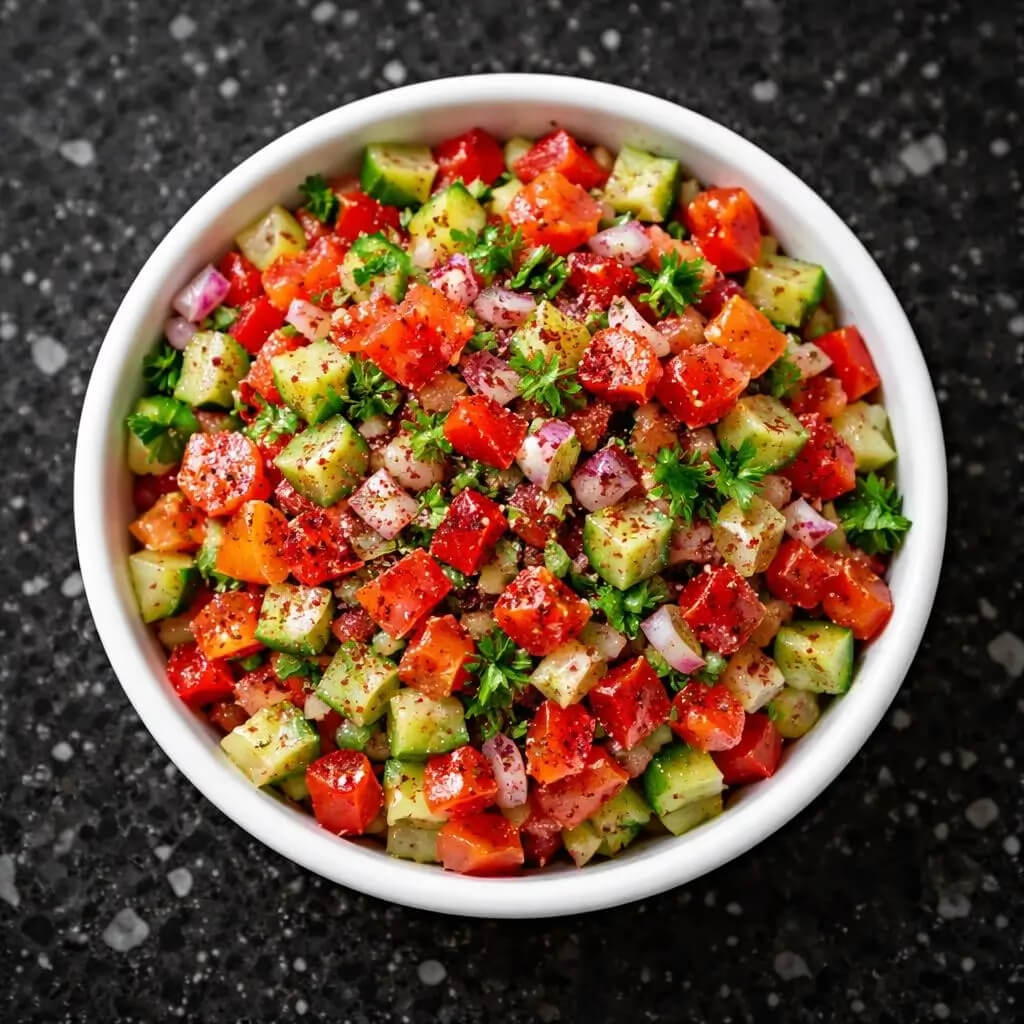
Israeli salad (salat yerakot) is an absolute staple – it appears at breakfast, lunch, and dinner. The secret lies in finely chopping the ingredients and using the freshest produce.
Ingredients:
- 4 ripe tomatoes
- 2 fresh cucumbers (small or medium)
- 1 red onion
- 1 bell pepper (any color, yellow or red works well)
- a handful of fresh parsley
- juice of 1 lemon
- 3–4 tablespoons olive oil
- salt, pepper, optional sumac for sprinkling
Preparation: Wash and dry the vegetables. Dice them into very small cubes – the smaller, the better. Rinse the chopped onion in cold water to mellow its sharpness. Place everything in a bowl, add chopped parsley, squeeze lemon juice over, drizzle with olive oil. Season with salt, pepper, and sumac if you have it. Let it sit for 10 minutes to allow the flavors to meld. Serve with hummus, falafel, pita – or simply on its own with good bread.
Why You Should Start Cooking Israeli Food
Cooking Israeli food is a genuine pleasure. You don’t need meat to create dishes with depth, variety, and character. Israeli vegetarian cuisine offers hummus, falafel, shakshuka, and salads – all relatively quick to prepare and tasting like the best street food from Tel Aviv. If you haven’t tried it yet, stock up on tahini, za’atar, and a good eggplant – and see for yourself why the world has fallen in love with these flavors.
While the sun-drenched markets of Tel Aviv offer one perspective on plant-based brilliance, the East holds its own ancient secrets. To see how another culture masters the art of meatless cooking, explore our guide to Vietnamese Vegetarian Cuisine, where the profound Chay tradition transforms simple ingredients into complex, soulful dishes.
FAQ – Frequently Asked Questions About Israeli Vegetarian Cuisine
1. What should I try in Israel as a vegetarian?
Definitely hummus, falafel, sabich, shakshuka, baba ghanoush, and Israeli salad. These are dishes you’ll find in every city and they best represent the cuisine.
2. Is falafel gluten‑free?
In its classic version – yes, it’s made from ground chickpeas and herbs without flour. In street food settings, a small amount of wheat flour is often added for binding, so it’s best to ask.
3. What is tahini and how do I use it?
Tahini is sesame paste – a foundation of Israeli cooking. It’s used in hummus, falafel sauces, salad dressings, and even desserts. You can thin it with water and lemon juice to make a creamy sauce.
4. What is za’atar and how is it used?
Za’atar is a blend of thyme, sumac, sesame, and wild herbs. It’s sprinkled over bread dipped in olive oil, salads, eggs, and grilled vegetables.
5. Can shakshuka be made vegan?
Yes. In modern vegan versions, simply omit the eggs or replace them with tofu. The tomato sauce is 100% plant‑based.
6. Where are the best places to eat vegetarian in Israel?
Tel Aviv, Jerusalem, and Haifa offer the highest concentration of vegetarian and vegan restaurants.
Look for spots labeled “vegan friendly” or traditional hummus bars.
Bibliography
- Gur, J. (2014). The Book of New Israeli Food: A Culinary Journey. Schocken Books.
- Raviv, Y. (2015). Falafel Nation: Cuisine and the Making of National Identity in Israel. University of Nebraska Press.
- Solomonov, M., Cook, S. (2015). Zahav: A World of Israeli Cooking. Houghton Mifflin Harcourt.
- Articles from Haaretz and The Times of Israel on vegan culture in Israel (2023–2024).
- Vegan Friendly (Israel) report – statistics and IDF program.
Disclaimer
The above article is for informational purposes only and does not constitute medical, dietary, or legal advice. Before making significant changes to your diet, especially if you have celiac disease, food allergies, or other conditions, it is recommended to consult a qualified dietitian or physician. The editorial team has made every effort to ensure the information presented is reliable and current as of the time of publication, but assumes no responsibility for any consequences arising from its use.