Vietnamese vegetarian cuisine has deep roots in ăn chay, a practice that grew out of Mahayana Buddhism. It’s not simply “food without meat” – it’s a whole approach to eating that balances yin and yang, plays with five fundamental tastes, and uses tofu, seitan, and mushrooms to create amazing plant‑based versions of familiar dishes. On the ground, this means everything from rich noodle soups and fresh spring rolls to curries and street snacks, where fish sauce is often swapped for soy sauce or, in many modern vegan kitchens, clever ferments made with pineapple, mushrooms, and soy that deliver that same deep umami.
- The „Chay” Phenomenon – Spiritual Roots
- Temple Kitchens and the Art of Imitation
- Five Flavors (Plus One) – What Makes It Work
- 5 Classic Chay Dishes You’ll Want to Track Down
- Eating Vegetarian in Vietnam – A Practical Playbook
- Recipe: Bún Chay – Rice Noodles with Tofu and Pineapple
- Is Vietnamese Cuisine Gluten‑Free Friendly?
- FAQ – Quick Answers
- Bibliography
- Disclaimer
The „Chay” Phenomenon – Spiritual Roots
In Vietnam, ăn chay means eating plant‑based, and it’s directly tied to Mahayana Buddhism. But it’s not just about ingredients—it’s also about cleansing the body and mind, showing compassion, and keeping yin and yang in check. Twice a month (the 1st and 15th days of the lunar calendar) you’ll see even regular meat‑focused restaurants roll out vegetarian menus. That’s how deeply woven chay cuisine is into daily life. Walk around any city, and you’ll spot quán chay signs—these are vegetarian‑only spots, and they’re everywhere, from busy Saigon to sleepy rural towns.
Temple Kitchens and the Art of Imitation. Vietnamese Vegetarian Cuisine
Here’s something that surprised me when I first traveled in Vietnam: Buddhist monks have been making fake meat for centuries. Seitan, tofu, textured soy—they turn these into “duck,” “ribs,” even “fish.” The texture, the look, the way it soaks up spices… it’s genuinely impressive. Monastery kitchens are where these skills were perfected, and today, modern Vietnamese plant‑based dishes still lean on that tradition. You’ll often find a mix of old‑school techniques and new twists—like a vegan pâté in a bánh mì that tastes nothing like cardboard.
Five Flavors (Plus One) – What Makes It Work
Vietnamese food, whether it’s vegetarian or not, plays with five tastes: spicy, sour, sweet, salty, bitter—and that deep umami hit that rounds everything out. In chay cooking, balance comes from heaps of fresh herbs (think mint, cilantro, Thai basil (húng quế)), lemongrass, lime, and little chilies that bring the heat without overwhelming. Fish sauce gets replaced by soy sauce or, in many modern vegan spots, inventive ferments using pineapple and mushrooms. The result? Meat‑free food that’s still punchy, layered, and never boring.
5 Classic Chay Dishes You’ll Want to Track Down
1. Phở chay – The Vegetarian Noodle Soup
Phở chay is the meatless sibling of Vietnam’s most famous dish. The broth simmers for a few hours with root veggies, charred onion and ginger, star anise, cinnamon, and cardamom.
No bones, no long‑haul overnight cooking—yet it develops real depth. Slurp it with rice noodles, shiitake mushrooms, tofu, and a mountain of fresh herbs on top. Many places serve it with a little bowl of vegan dipping sauce on the side. Don’t skip that.
2. Bánh mì chay – The Classic Street‑Food Sandwich
That French baguette meets Vietnamese fillings: a crispy roll stuffed with plant‑based pâté (usually tofu or mushroom, sometimes lentil), pickled carrots and daikon, cucumber, cilantro, and a swipe of vegan mayo. It’s the kind of thing you grab from a cart, eat with one hand while walking, and immediately want another. Vegetarian bánh mì is so good that even non‑vegetarians order it.
3. Gỏi cuốn – Fresh Spring Rolls
Rice paper rolls filled with vermicelli, tofu, mint, cilantro, and sometimes scallions. Dip them in peanut sauce or fermented soybean dip. They’re light, refreshing, and feel almost healthy—though you might find yourself eating four in a row. Gỏi cuốn (spring rolls) are a perfect example of how Vietnamese vegetarian food can be simple yet totally satisfying.
4. Bánh xèo – Coconut Milk Pancakes (Southern Style). Vietnamese Vegetarian Cuisine
These sizzling pancakes are made from rice flour, turmeric, and—in the southern style—coconut milk. They’re crisp at the edges, soft in the middle, and stuffed with bean sprouts, mushrooms, tofu, and herbs. You wrap a piece in lettuce or mustard leaves, dip it in sweet‑sour sauce, and crunch your way to happiness. Vegetarian bánh xèo is a textural adventure.
5. Cơm tấm chay – Broken Rice with Tofu and Veggies
Broken rice—the slightly fragmented grains that were once considered “lower grade” but are now beloved—served with grilled tofu, pickles, cucumber, lettuce, and a vegan nước chấm. It’s everyday food, filling without being heavy. If the place adds a few seitan cracklings, consider yourself lucky.
Eating Vegetarian in Vietnam – A Practical Playbook
Is it easy to be vegetarian in Vietnam? Short answer: yes, if you know a few tricks. Here’s what I’ve learned from wandering its markets and sitting down at countless quán chay.
- Look for “Quán Chay” on the sign. That’s your shortcut. These places exist in every city, and often in the smallest towns. They’re 100% plant‑based.
- Beware fish sauce (nước mắm). It sneaks into soups, dipping sauces, marinades. In vegetarian spots, they’ll use soy sauce or a vegan mushroom‑pineapple sauce instead. When in doubt, ask: “Có nước mắm không?” (Is there fish sauce?)
- Fasting days are your friend. On the 1st and 15th of the lunar month, many non‑vegetarian restaurants offer separate chay menus. Great chance to try a meat‑focused place’s plant‑based take.
- Learn a few phrases. “Tôi ăn chay” (I eat vegetarian), “Món chay” (vegetarian dish), “Không thịt, không cá” (no meat, no fish). In tourist areas, English works fine, but a little effort gets you a smile.
Recipe: Bún Chay – Rice Noodles with Tofu and Pineapple
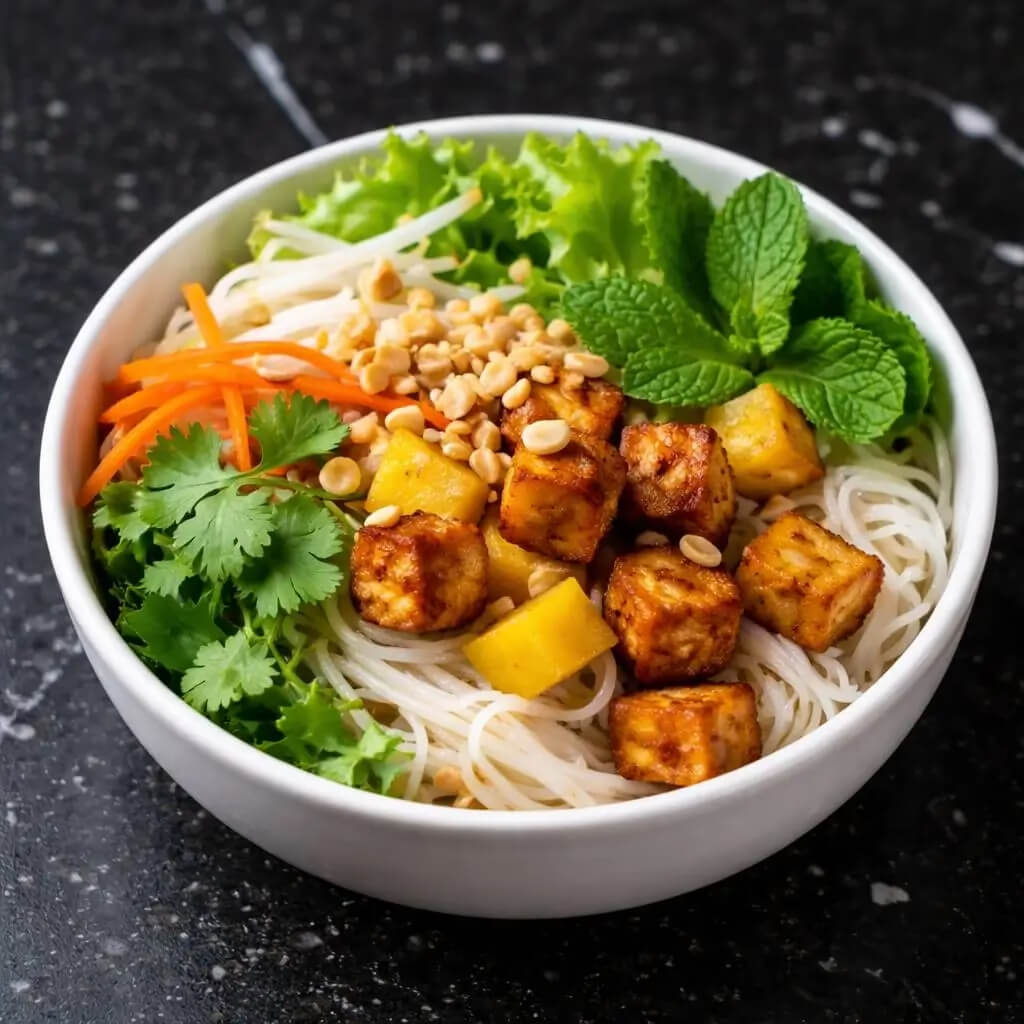
Bún chay is essentially a rice noodle salad inspired by classic bún chả (the grilled‑pork version). In this modern plant‑based take, we add pineapple (or green mango) to bring in the tangy‑sweet note you often find in southern Vietnamese cooking. It’s bright, it’s filling, and it’s surprisingly easy to throw together on a weeknight.
Preparation time: 30 minutes
Calories: roughly 450–500 kcal per serving (without peanuts)
Ingredients (serves 2):
- 200 g vermicelli (thin rice noodles)
- 250 g firm tofu
- 1 small pineapple (or 1 green mango)
- 2 tbsp soy sauce (use gluten‑free tamari if needed)
- 1 tbsp sesame oil
- 1 garlic clove, minced
- 1 small onion, sliced
- 1 carrot, julienned
- handful of bean sprouts
- fresh mint, cilantro, lettuce
- 2 tbsp chopped peanuts
- juice of 1 lime
- optional: fresh chili pepper
Step‑by‑step:
- Cook the noodles according to the package directions, drain, and rinse with cold water. Set aside.
- Pat the tofu dry with paper towels—this helps it get crispy—and slice into 1‑cm thick pieces.
- Heat the sesame oil in a pan. Toss in the onion and garlic, sauté for about a minute. Add the tofu and fry until both sides are golden brown. Don’t rush it; this is where the flavor starts.
- Add the soy sauce and the finely diced pineapple (or mango). Stir‑fry for 2–3 minutes until the fruit starts to caramelize and the whole pan smells like a tropical dream.
- Now build your bowls: noodles on the bottom, then the tofu‑pineapple mixture, carrot ribbons, bean sprouts, lettuce, and a generous sprinkle of herbs and peanuts.
- Squeeze lime over everything. Serve with extra soy sauce and a few slices of fresh chili if you want some heat.
Tips:
If your tofu sticks a little, that’s normal—just use a thin spatula and scrape it up. For a gluten‑free version, make sure your soy sauce is certified gluten‑free. And if you want to go full Viet, serve with a side of peanut sauce (tương đậu phộng) for dipping.
Is Vietnamese Cuisine Gluten‑Free Friendly?
Because rice is the star—rice noodles, rice paper, rice flour—Vietnam is generally a good place for gluten‑free travelers. But you have to watch out for a few things: traditional soy sauce contains wheat, and some soups or braises use flour as a thickener. In dedicated chay restaurants, you’ll often find gluten‑free tamari or house‑made sauces. Dishes like phở chay, gỏi cuốn, bánh xèo (rice‑flour batter), and cơm tấm are usually safe. Still, it never hurts to ask about the sauce—a quick “không bột mì?” (no wheat flour?) can save you trouble.
Hungry for more? Explore the Vegetarian Cuisine of Armenia and discover the soul-warming flavors of the Caucasus, where pomegranate, walnuts, and fresh herbs take center stage.
FAQ – Quick Answers. Vietnamese Vegetarian Cuisine
What does chay cuisine mean in Vietnam?
It’s plant‑based cooking rooted in Buddhist fasting. No meat, no fish, and often no dairy or eggs—just vegetables, tofu, seitan, and clever seasoning.
Are Vietnamese spring rolls always vegetarian?
No. Traditional ones (chả giò) pack pork and shrimp. The vegetarian version is chả giò chay—filled with tofu, mushrooms, veggies, and rice noodles.
How can I tell vegetarian phở from meat phở?
Look for “phở chay” on the menu. The broth is clearer, smells more of spices than bones, and comes with tofu or mushrooms instead of beef.
Can vegans find suitable food in Vietnam?
Yes—most chay food is naturally vegan. They’ve been using plant‑based fish sauce substitutes and coconut oil for decades. You’ll feel right at home.
How do I order food without meat and fish sauce?
Just say: “Tôi ăn chay” (I eat vegetarian) and “Không nước mắm” (no fish sauce). In tourist spots, “vegetarian, no fish sauce” works perfectly.
Bibliography
- Nguyễn, N. (2020). Vietnam: The Vegetarian Kitchen. Hanoi Publishing House.
- Phạm, T. (2018). Ăn Chay – Buddhist Vegetarianism in Vietnam. Journal of Vietnamese Studies, 13(2), 45–68.
- Avieli, N. (2012). Rice Talks: Food and Community in a Vietnamese Town. Indiana University Press.
- Lonely Planet (2023). Vietnam – Food & Drink Guide.
- Articles from Saigon Times and Vietnam News on chay culture (2021–2024).
- Food blogs: Vietnam Vegan, Chay Corner.
Disclaimer
The above article is for informational purposes only and does not constitute medical, dietary, or legal advice.
Before making significant changes to your diet, especially if you have celiac disease, food allergies, or other conditions, it is recommended to consult a qualified dietitian or physician. The editorial team has made every effort to ensure the information presented is reliable and current as of the time of publication, but assumes no responsibility for any consequences arising from its use.